The most expensive problem in a startup isn’t always the market
A startup can survive a bad product decision. It can survive a failed marketing campaign. What becomes significantly harder to manage is misalignment between the people responsible for deciding what the company becomes.
In the early stages, startups naturally operate with a high degree of informality. Founders share responsibilities, decisions happen quickly, and agreements are often made through conversations rather than formal documents. That flexibility is useful when a company is small. But as the company grows, ambiguity becomes more expensive.
A 2025 systematic literature review published in the Review of Entrepreneurship examined 43 studies specifically focused on conflict among entrepreneurial co-founders. The research highlights that founding teams have characteristics that make their conflicts different from those found in conventional teams, including informal power structures, ambiguity, competitive dynamics, urgency in decision-making and shared interpersonal history.
That last point is particularly interesting. Founders are not simply colleagues. They often build the company before formal structures exist. Roles evolve while the product evolves. Influence develops organically. One founder may become more involved in technology, another in sales, another in operations. Decisions that were once made casually can eventually determine ownership, authority and the strategic direction of the company. This is where a disagreement about the business can become a governance problem.
Research distinguishes between different forms of conflict within teams. Disagreement about tasks, strategy or execution can sometimes improve decision-making. The risk increases when disagreements become intertwined with unclear roles, informal power or competing expectations about authority and ownership.
This is why governance matters. Founder agreements, IP assignments, equity and vesting arrangements, decision-rights frameworks and dispute mechanisms are not necessarily signs of bureaucracy. They are mechanisms for reducing ambiguity.
A good founder agreement does not need to predict every possible future disagreement. It needs to answer the questions that become expensive when left unanswered:
- Who owns the intellectual property?
- How is equity divided and vested?
- What is each founder responsible for?
- Which decisions require mutual agreement?
- Who has authority over specific areas?
- What happens if a founder leaves?
- How are disagreements resolved?
These questions can feel unnecessary when everything is going well. They become much more important once the company has customers, employees, revenue, intellectual property or outside investment. Y Combinator similarly recommends discussing roles, titles, equity, responsibilities, commitment and long-term expectations before starting a company together. It also recommends testing the working relationship through a trial project and maintaining regular founder communication.
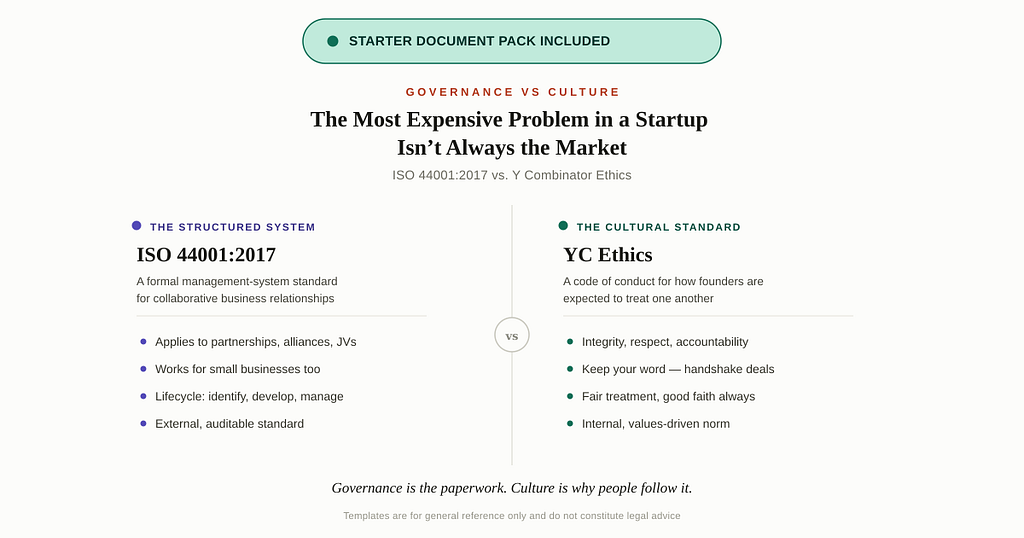
YC also emphasises that its network is built on trust and shared values such as integrity, respect and accountability, and that founders are expected to act in good faith in all interactions. This includes being honest with co-founders, employees and investors, avoiding misleading or unethical behaviour, and respecting confidentiality.
It also recognises that not every agreement in the early stages is formalised in writing; even informal or verbally made understandings between founders are expected to be honoured in good faith, as these “handshake agreements” often form the foundation of trust before legal structures are fully in place.
There is also a broader management framework for collaborative relationships. ISO 44001:2017 provides a structured approach to establishing and managing collaborative business relationships, including partnerships, alliances and joint ventures.
Its structure walks organisations through eight stages grouped into three broader phases: a strategy phase focused on internal readiness and understanding the case for collaboration, an engagement phase covering partner selection and joint value creation, and a management phase concerned with sustaining the relationship over time and planning an orderly exit when the partnership eventually ends.
This does not mean founders should start with layers of corporate bureaucracy. It means that the informal assumptions that work at the beginning should eventually be converted into explicit structures as the company becomes more valuable. The strongest founding teams do not eliminate disagreement. They create enough clarity around ownership, responsibility and decision-making that disagreement can remain focused on the business. A startup does not need perfect founder alignment. It needs enough clarity for disagreement to remain productive.
The principle is straightforward:
Trust helps founders move quickly. Governance helps the company keep moving when decisions become difficult.
This is why businesses need governance and documentation, not as a matter of individual preference, but as something essential to the survival of the company itself. Because sometimes the biggest risk to a growing company isn’t the market outside it. It’s the ambiguity inside it.
You can find ready-to-use templates for several of these documents such as Agreements, Contractor Agreements, Employment Agreements, NDAs, MSAs and SOWs here: Startup Document Templates
Templates are provided for general reference only and do not constitute legal advice.
Sources
- Ghanei, Y., Jaouen, A., Nakara, W. A., & Sammut, S. (2025). Exploring Conflict Dynamics in Entrepreneurial Founding Teams: A Systematic Literature Review and Future Research Agenda. Revue de l’Entrepreneuriat / Review of Entrepreneurship, 24(3), 93–125.
- Y Combinator — Ethics: https://www.ycombinator.com/ethics
- ISO 44001:2017 — Collaborative business relationship management systems: https://www.iso.org/standard/72798.html