From data-driven organisations to AI-driven individuals
How Systems Thinking Is Quietly Reshaping Work
In recent years, becoming data-driven has shifted from a competitive advantage to a baseline expectation for organizations. Companies that systematically measured user behavior, operational efficiency, and outcomes consistently outperformed those relying on intuition alone.
Empirical evidence from large-scale studies supports this shift: research from Harvard Business School shows that startups engaging in structured experimentation and data-driven decision-making scale faster and attract more investment than those guided primarily by gut instinct (HBS, 2017).
I previously wrote about why this transition toward data-driven thinking was almost inevitable at the organisational level. Lately, however, I’ve been reflecting on a closely related but underexplored question: what happens when the same logic is applied at the individual level?
My view is that artificial intelligence is now enabling a new working model, one in which individuals can operate with a level of leverage that previously required entire teams.
This is not a claim that companies will disappear or that collaboration will lose relevance. Rather, it suggests that the minimum efficient scale of work is changing. Tasks that once demanded coordination across multiple roles, analysis, content production, basic design, reporting, customer communication, can increasingly be orchestrated by a single individual using AI-based systems.
In this sense, AI begins to resemble less a “tool” and more an operational layer.
From Data as Input to AI as Infrastructure

Data-driven organizations learned to treat data not as a by-product of operations, but as an active input into decision-making. Metrics became shared reference points, experimentation reduced uncertainty, and feedback loops accelerated learning. Over time, this logic reshaped how products were built, how teams aligned, and how risk was managed.
AI extends this logic one step further.
Rather than merely informing decisions, AI systems increasingly execute, coordinate, and adapt. Large language models, generative design tools, automated analytics, and agent-based workflows can now translate high-level intent into concrete outputs. This allows individuals to focus less on execution and more on direction.
Economists Erik Brynjolfsson and Andrew McAfee have described this shift as a move toward “augmentation rather than automation,” where human judgment is amplified rather than replaced (Brynjolfsson & McAfee, The Second Machine Age).
At the individual level, this augmentation compounds quickly. One person equipped with AI systems can test ideas, launch offerings, analyse feedback, and iterate at a pace that previously required a small team.
The One-Person System, Not the One-Person Hustle

I often think of this emerging model as a one-person system or, informally, a “one-person factory.” Not in the sense of doing everything manually, but in overseeing a structured system that handles repeatable and scalable work.
The individual’s role shifts from execution to orchestration. Decisions revolve around setting goals, defining constraints, evaluating outputs, and deciding where human judgment is still essential. This mirrors how effective managers operate inside larger organizations, but compressed into a single actor with machine-supported leverage.
From a business perspective, the implications are significant. Cost structures become lighter, decision cycles shorten, and experimentation becomes cheaper. A consultant, creator, or founder can explore opportunities without committing to a full organizational setup.
Research from McKinsey suggests that AI-enabled workflows can reduce time spent on routine cognitive tasks by 30–40%, effectively expanding individual capacity without proportional increases in cost (McKinsey Global Institute, 2023).
Creative and Experiential Work at Smaller Scales

This logic is not limited to analytical or operational domains. Creative industries may feel its impact just as strongly. Advances in generative visuals, sound synthesis, and real-time adaptation enable small teams, or even individuals, to design experiences that once required large production crews.
What changes here is not merely efficiency, but control and speed. Smaller units can iterate faster, maintain creative coherence, and respond dynamically to audiences. The value shifts from scale for its own sake to adaptability and precision.
Stanford’s Human-Centered AI Institute notes that as generative systems mature, creative direction and contextual judgment become the primary differentiators, areas where humans still outperform machines when paired effectively with AI (Stanford HAI Report, 2024).
Staying Small by Design

This is not a universal trajectory. Many organizations will continue to benefit from deep specialization, large teams, and complex structures. However, alongside them, I expect to see a growing class of professionals who stay small by design, not due to lack of ambition, but because technology allows them to operate efficiently without expanding headcount.
Historically, scaling output required scaling people. AI disrupts that assumption. Output, reach, and experimentation can now grow independently of organizational size. This decoupling has long-term implications for entrepreneurship, consulting, and creative work.
Forward Projections: What Likely Comes Next
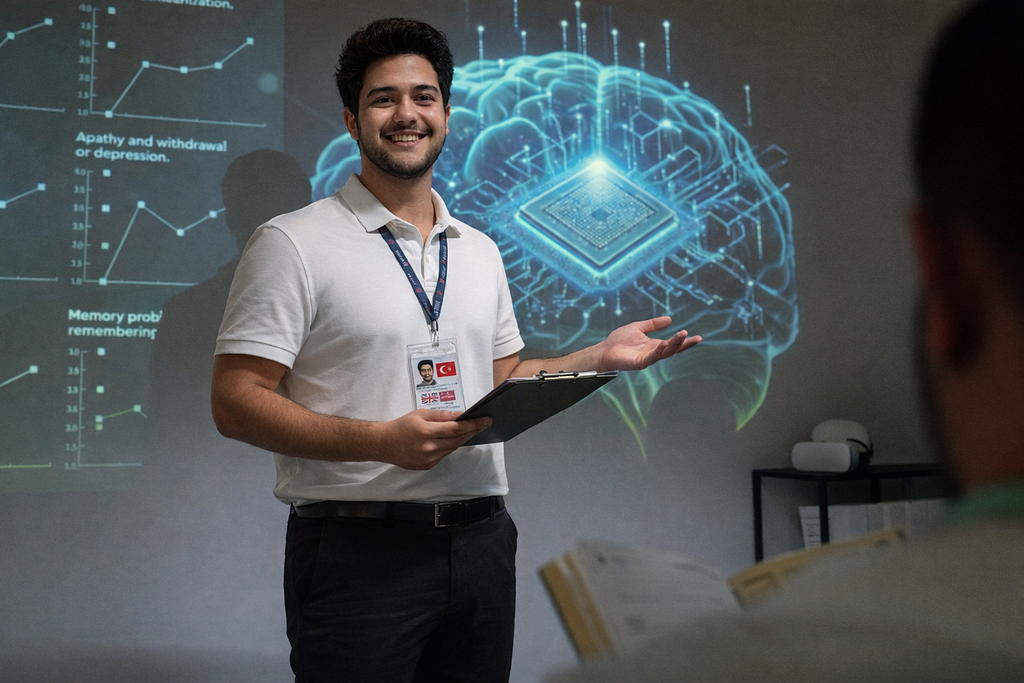
Looking ahead, several trends appear plausible rather than speculative.
First, AI-assisted work is likely to become a baseline expectation, much as data literacy did over the past decade. Individuals who cannot design, manage, or critically engage with AI-supported systems may face constraints similar to organizations that once ignored data altogether.
Alongside this shift, personal operational stacks are likely to emerge.
Custom combinations of AI tools, workflows, and data pipelines , tailored to individual goals, will increasingly function as a form of competitive advantage. These systems will be difficult to replicate without hands-on experimentation and accumulated judgment.
As execution becomes cheaper, the true bottleneck moves upstream.
Strategic value will concentrate around judgment: deciding what to build, why it matters, and when human involvement is essential. In an environment of abundant capability, clarity of intent becomes the scarce resource.
For me, this is not about forecasting a radical future.
It is about recognizing a gradual shift already underway. Just as being data-driven became a baseline organisational requirement, AI-assisted systems thinking is likely to become a baseline capability for individuals.
Those who learn to design, govern, and evolve these systems early
are likely to gain not only efficiency, but strategic freedom, over how they work, what they build, and the scale at which they choose to operate.
References & Further Reading
- Brynjolfsson, E., & McAfee, A. (2014). The Second Machine Age. W. W. Norton.
- Harvard Business School. (2017). Experimentation and Startup Performance.
- McKinsey Global Institute. (2023). The Economic Potential of Generative AI.
- Stanford Human-Centered AI Institute. (2024). AI Index Report.
- Ries, E. (2011). The Lean Startup. Crown Publishing.
- OpenAI. (2023). GPT-4 Technical Report.